Moral Test Results Explained: Read the Score Without Ranking Your Character
Congratulations on completing the Moral Test! You've taken a significant step toward deeper self-understanding. Receiving your report is just the beginning of a fascinating journey into your ethical core. The process of having your moral test results explained can feel illuminating, and this guide is here to help you navigate your personalized report. How do I figure out my morals and values from these results?
By Julian Croft · Updated November 3, 2026
Moral test results describe how a questionnaire processes your answers. They do not establish how good you are, how you compare with a country, or which decision you should make next. On this website, the basic result is one overall score out of 100. It is useful to understand what that display contains before treating it as a detailed ethical profile.
Start with the single overall result from the moral reflection questionnaire. Distinguish its scoring from published research instruments, then use the score-to-context table below. You can use the table without accepting a label or sharing your result with anyone.

What the basic result actually displays
The website presents 48 statements with seven response options. Its scoring combines six groups of eight items: Care/Harm, Fairness/Cheating, Loyalty/Betrayal, Authority/Subversion, Sanctity/Degradation, and Liberty/Oppression. The overall score is the average of those six dimension scores, on a 0–100 scale.
The basic page displays “Score X / 100” and a percentage. It does not display separate dimension scores or score bands. You should therefore not read the single visible number as evidence that care is your highest value or loyalty your lowest. Those are different claims requiring information the basic display does not provide.
The percentage is also not a probability that you are ethical, a percentile among other people, or a percentage of correct answers. It is a presentation of the site's score. A number can look precise while still answering a limited question.
| What you see or read | What you can say | What you should not infer |
|---|---|---|
| One overall score | The site's scoring produced this result from these responses | My position in a population ranking |
| A percentage beside the score | The result is displayed on a percentage-style scale | The probability that I will act ethically |
| A broad value label | This is language I can examine | This establishes my character |
| A different result on another test | The tools or answers differ | One score proves moral improvement or decline |
Why the research name and website score are different
Published moral foundations research provides background for studying moral concerns. Graham and colleagues' questionnaire differs from this site's adaptation in item count, response structure, and foundations. Atari and colleagues' later framework also has a different set of foundations. A shared topic does not make the scores interchangeable. [2,3]
In particular, do not call this website's result an MFQ score or apply a published MFQ group's averages to it. There is no crosswalk established here between the website's number and a research questionnaire's score. The score has no established clinical cutoff for moral character. [2,3]
The guide to what a moral test is explains the broader categories of reflection tools. Names such as moral foundations test, ethical compass test, and moral alignment test can refer to different tasks. Check the exact instrument before comparing numbers.
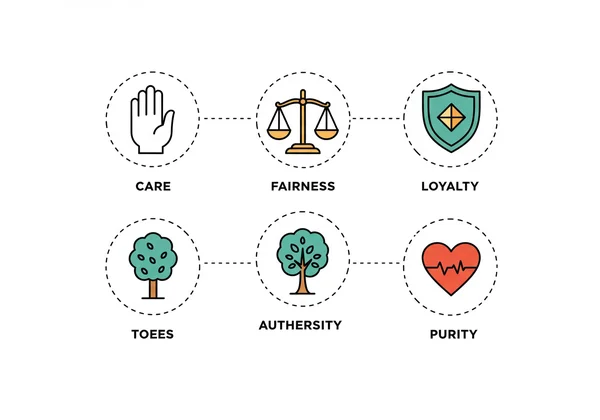
For access conditions and completion guidance, inspect the current service page before entering information. Choose the tool for voluntary self-reflection, rather than diagnosis, hiring, or judging someone else. A result can help organise a question; it does not answer a professional or clinical assessment. This website's scoring labels below differ from Graham's original foundations, including the site's use of Liberty/Oppression.
Read the value labels as questions about answers
The website's six scoring labels can help you locate a topic you want to discuss. They should not be treated as six independent character certificates. For a practical reading, ask about a specific answer rather than attaching a fixed identity to the label.
| Label used by the site | A reflection question to ask yourself |
|---|---|
| Care/Harm | Whose needs or possible suffering did I notice? |
| Fairness/Cheating | What did I consider a fair process or distribution? |
| Loyalty/Betrayal | What commitment to a person or group mattered? |
| Authority/Subversion | Which rule or responsibility did I accept or question? |
| Sanctity/Degradation | What did I regard as deserving special respect? |
| Liberty/Oppression | Whose choice or freedom seemed constrained? |
Use these reflection questions to examine an actual decision. You may disagree with a label or find that several questions fit the same decision. You can describe that uncertainty in ordinary language.
A label also does not settle a disagreement. Saying “I value fairness” does not establish which proposed solution is fair. You still need facts about the situation, the people affected, and the tradeoffs between options.
Why agreeing with a value is different from acting on it
A response records what you endorsed while answering. Acting on that concern may require information, time, an opportunity to intervene, or a willingness to accept a cost. Ellemers and colleagues' review cautions that self-reported dispositions and stated intentions may not accurately predict moral behavior. [4] A score therefore needs a concrete event beside it if you want to understand what you actually did.
Schwartz's values framework makes a related distinction: valuing a goal does not mean possessing the corresponding trait, and behavior reflects tradeoffs among relevant values. [5] Someone can value honesty while struggling to correct an error that would embarrass a friend. The practical question is how they handle that conflict, not whether the word honesty appears in their preferred description.
Try adding three notes to one difficult response: the situation you pictured, another situation in which you would answer differently, and the action you took most recently. If the examples point in different directions, keep the difference. It may explain more than averaging them into a character label.
Work through a score-to-context example
Here is a fictional example. Rowan saves a result of 62 out of 100. The number is illustrative, not a population average, an actual user record, or a threshold. Rowan initially thinks it means “I am moderately ethical.” The display does not support that interpretation.
Rowan instead chooses one statement they found hard to answer. They remember a decision about helping a friend apply for a shared opportunity. Loyalty and fair access both mattered. The useful note is about that tension, not whether 62 is good enough.
Rowan records what they actually did, what information was missing, and which alternative they would consider next time. The result can remain in the record, but it no longer does the work of deciding the meaning of the event.
| Reading step | Rowan's note | What stays open |
|---|---|---|
| Identify the display | One overall score | No separate dimension ranking was shown |
| Choose an answer | A statement about obligations felt difficult | The wording may not fit the real situation |
| Add an event | A friend requested help with an application | What help the process permits |
| Describe the conflict | Loyalty and equal access both mattered | Whether a different option could respect both |
| Plan one question | Can I explain the application process without influencing selection? | The answer depends on the actual rules |
The useful entry is the question Rowan can investigate: which form of help respects both the friendship and the application process?

What a result cannot tell you
A questionnaire score cannot prove honesty, predict whether someone will break a promise, or decide the fairness of an employment decision. It should not be used as a character reference or as evidence against someone in a conflict.
It also cannot translate directly into a fictional alignment label. A website score does not place you in a fantasy grid, and being uncertain between fictional alignments does not imply anything about mental health.
Keep any interpretation attached to the actual response and situation. A claim about a “dominant philosophy” or the cause of behaviour can go beyond what answers establish. Ask which example supports the claim rather than accepting it as a personal identity.
Comparing results over time
If you save another result later, also save the version and the circumstances of answering. A changed score alone does not establish growth or decline. You may have interpreted an item differently or used another version of the tool.
For a practical comparison, describe the decisions you made and what changed in your reasoning. “I checked who would be affected before agreeing” is an observation you can examine. “My score rose, so I became a better person” adds a conclusion the number cannot establish.

Choose a next step that fits your actual question
If you want to understand your priorities, choose one answer and add a concrete example. If you want to discuss results with others, the respectful results discussion guide addresses consent and comparison. If you already have a specific commitment, the 30-day ethical action plan keeps the focus on behavior rather than increasing a score.
Seek qualified support if a conflict or persistent distress affects daily life. If there is immediate danger or a risk of self-harm, contact local emergency or crisis support rather than relying on a questionnaire or AI explanation.
Frequently Asked Questions About Moral Test Results
What does it mean if someone lacks a moral compass?
It is a broad judgment, not something this questionnaire can determine. Name the specific action, its impact, and the boundary or accountability needed. A score should not replace that conversation.
What are the 12 moral values?
There is no single list established by this website result. Schwartz's theory describes ten broad values: self-direction, stimulation, hedonism, achievement, power, security, conformity, tradition, benevolence, and universalism [5]. The divisions are an analytical convenience, and priorities and tradeoffs matter more than treating an online list as an official moral checklist.
What is an example of a moral compass?
A person might explain, “I wanted to help my friend, but I also wanted everyone to have a fair application process.” The explanation names competing priorities. A questionnaire can prompt reflection, but the concrete decision still needs context.
References (4)
- Graham J, et al. Mapping the moral domain. Journal of Personality and Social Psychology. 2011;101(2):366–385. doi: 10.1037/a0021847.
- Atari M, et al. Morality beyond the WEIRD: How the nomological network of morality varies across cultures. Journal of Personality and Social Psychology. 2023;125(5):1157–1188. doi: 10.1037/pspp0000470.
- Ellemers N, van der Toorn J, Paunov Y, van Leeuwen T. 2019. The Psychology of Morality: A Review and Analysis of Empirical Studies Published From 1940 Through 2017. Personality and Social Psychology Review. doi: 10.1177/1088868318811759.
- Schwartz SH. 2012. An Overview of the Schwartz Theory of Basic Values. Online Readings in Psychology and Culture. doi: 10.9707/2307-0919.1116.