Moral Foundations Theory: Take Our Free Moral Test to Discover Your Core Values
Have you ever wondered why you and a friend can look at the same political issue or social debate and come to completely different conclusions? You both want what's best, yet you can't agree on what "best" even means. This isn't just about opinions; it's about the deep, often invisible, wiring of our moral minds.
This article explores the groundbreaking Moral Foundations Theory, a framework that acts like a decoder for our ethical instincts. It reveals the psychological pillars that support our sense of right and wrong. Understand these foundations. You'll unlock insights into your values. Plus, you'll get why others disagree.
Understanding your unique moral profile is the first step toward greater self-awareness and clearer decision-making. A powerful way to start this journey is by taking a free moral test designed to map your ethical compass.
Understanding the Moral Foundations Theory
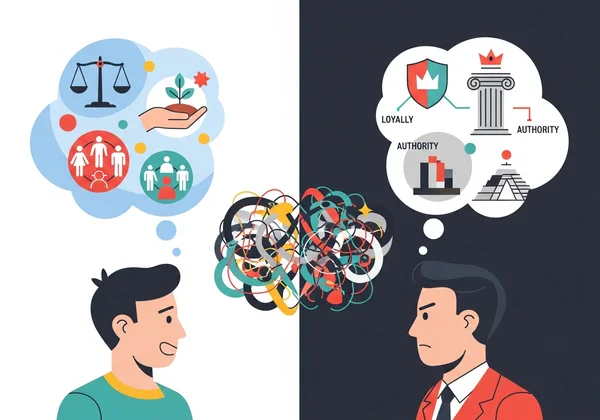
Moral Foundations Theory is a powerful tool for looking under the hood of human morality. It suggests that our moral judgments are not just based on logic and reason but are driven by quick, intuitive emotional responses. Developed by social psychologists, this theory helps explain why morality varies so much across different cultures and individuals, yet still shares a common set of underlying themes.
Origins of Moral Psychology: How We Got Here
For centuries, philosophers believed that moral decisions were a product of careful, conscious reasoning. However, modern psychology has shown that our gut feelings often come first. We instantly feel that something is right or wrong, and then our logical brain works backward to justify that feeling.
Researchers like Jonathan Haidt compare morality to a tongue's six taste receptors. You might be super-sensitive to fairness or compassion. Others lean on loyalty or authority. This shift in focus from pure reason to underlying intuitions revolutionized how we study ethics.
Why This Framework Matters for Self-Understanding
Understanding your personal combination of these ethical pillars is like getting a blueprint of your ethical self. It helps you answer critical questions: What truly drives my moral decisions? Why do certain issues make me emotional, while others don't?
This knowledge is incredibly empowering. Spot your biases. Play to your ethical strengths. Fill in those blind spots. Instead of being guided by unconscious reactions, you can begin to make more conscious, informed choices that align with your deepest values. This clarity is essential for personal growth and building stronger relationships.
The Six Core Ethical Pillars Explained
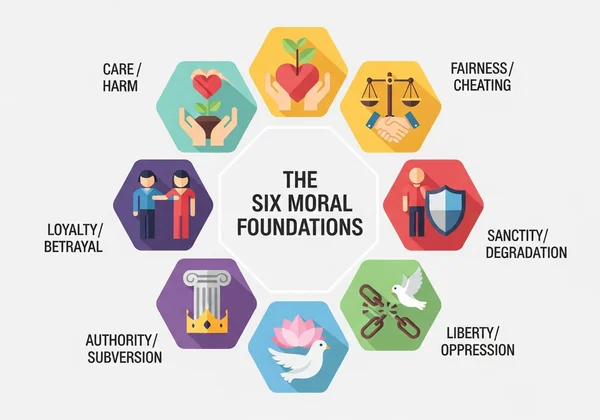
The theory outlines six key ethical pillars, each with a positive and negative pole. Think of them as pairs of opposing concepts that trigger our moral intuitions. Most of us use all six, but we prioritize them differently.
Care/Harm: Empathy and Protecting the Vulnerable
This is the foundation of compassion and empathy. It’s rooted in our long evolution as mammals with attachments to our children. It makes us sensitive to suffering, cruelty, and the needs of others. When you feel a pang of sadness seeing an animal in distress or feel compelled to help someone who is hurt, you are responding to the Care/Harm foundation.
Fairness/Cheating: Justice, Rights, and Reciprocity
This foundation is built on the principles of justice, rights, and equality. It drives our desire for proportionality—that people should get what they deserve, and cheaters should be punished. It’s the feeling of outrage you get when you see someone cut in line or a system that treats people unequally. It governs our ideas about fairness, whether in a playground game or a court of law.
Loyalty/Betrayal: Group Identity and Patriotism
As social creatures, we evolved to form cohesive groups to survive. The Loyalty/Betrayal foundation underlies our feelings of group identity, patriotism, and self-sacrifice for the team. It’s the pride you feel for your family, your company, or your country. This foundation makes us trustworthy members of a coalition, but it can also create a sharp "us versus them" mentality.
Authority/Subversion: Hierarchy, Respect, and Order
This foundation is about recognizing legitimate hierarchies and showing respect for authority and tradition. It’s based on our history of living in social structures that require leadership and followership to function. When you feel that it's important to respect your elders, obey the law, or uphold traditions, you are tapping into the Authority/Subversion foundation. It values social order and stability.
Sanctity/Degradation: Purity, Morality, and Spirituality
The Sanctity/Degradation foundation is rooted in the idea that some things are pure, sacred, or noble, while others are contaminating or degrading. Originally related to avoiding pathogens and contaminants, it has expanded to include more abstract ideas about living a more elevated, less carnal life. This foundation often informs our beliefs about spirituality, piety, and the sanctity of the body.
Liberty/Oppression: Freedom, Rights, and Resistance
This is the most recently added foundation. It’s about the feeling of resentment we have toward those who dominate, bully, or oppress us. The Liberty/Oppression foundation fuels our desire for freedom and our resistance to being controlled. It's the rallying cry for individual rights and personal autonomy, often standing in tension with the Authority foundation.
Applying the Theory: From Insight to Your Test Results
Learning about the six foundations is fascinating, but the real power comes from applying this knowledge to your own life. The best way to do this is to discover your unique moral profile. A well-designed moral assessment test can measure how strongly you rely on each of the six foundations.

Decoding Your Moral Compass Test Results
After completing a test, you'll receive a profile showing your scores for each foundation. For example, you might find you score very high on Care and Fairness but relatively low on Loyalty and Authority. This doesn't mean you are "good" or "bad"—it simply reveals your ethical priorities. This profile is your personal moral compass, highlighting the intuitive directions you lean toward when making decisions.
Real-Life Scenarios: Foundations in Action
Imagine a debate at work about a new policy that gives a large bonus to top performers but freezes salaries for everyone else.
- An employee high in Fairness might see this as unjust and unequal.
- Someone high in Authority might trust leadership's decision and see it as necessary for order.
- A person high in Loyalty might wonder if this policy will hurt team morale and group cohesion.
None of these perspectives are inherently wrong; they just originate from different ethical pillars.
The Strengths and Challenges of Different Moral Profiles
Every moral profile has unique strengths and potential blind spots. Someone high in Care is likely deeply compassionate but may struggle to make tough decisions that cause short-term harm for a long-term good. A person high in Loyalty is a dedicated team player but might overlook ethical issues within their own group. Understanding your profile helps you leverage your strengths and be mindful of your challenges.
Unlock Deeper Self-Understanding & Ethical Growth
Knowing your ethical profile is more than just an interesting piece of trivia about yourself. It's a practical tool for personal development that can improve your life in tangible ways. It maps your inner world. Navigate relationships with real wisdom.
Improving Interpersonal Understanding and Communication
Once you understand that people operate from different moral matrices, conversations with those you disagree with can become more productive. Instead of seeing them as irrational or ill-intentioned, you can recognize that they are simply prioritizing a different set of values. This fosters empathy and opens the door for more constructive dialogue, reducing conflict in your personal and professional life.
Navigating Ethical Dilemmas with Greater Clarity
Facing a tough choice? Use the six foundations as a checklist. Ask yourself about the implications for Care, Fairness, and Loyalty. This structured approach moves you past your initial gut reaction to see the dilemma from multiple angles. It allows for a more balanced and thoughtful decision-making process, helping you find a path that aligns with your core self. To begin this process, you can start your test and see your results.
Fostering Personal and Professional Development
Recognizing your ethical core is a cornerstone of authentic leadership and personal integrity. By understanding what truly matters to you, you can set goals, build a career, and create a life that feels meaningful and true to your values. This self-awareness is invaluable for leaders building team culture, professionals navigating workplace ethics, and anyone committed to a life of purpose.
Discover Your Ethical Blueprint: Start Your Moral Journey Today
Moral Foundations Theory offers a profound and accessible way to understand the hidden forces that shape who we are. It’s a map to your own ethical world, revealing the core values that guide your actions, beliefs, and relationships. It shows us that morality is not a simple matter of right and wrong, but a rich and complex tapestry woven from universal psychological threads.
Understanding your unique ethical blueprint is the first step toward greater self-awareness, improved relationships, and more confident decision-making. You can move from being unconsciously guided by your intuitions to consciously navigating life with your values as your guide.
Ready to uncover the foundations of your moral compass? Start your free moral test now and begin your journey of ethical self-discovery.
Frequently Asked Questions About The Theory and Your Values
What are the 6 moral foundations, and why are they important to understand?
The six moral foundations are Care/Harm, Fairness/Cheating, Loyalty/Betrayal, Authority/Subversion, Sanctity/Degradation, and Liberty/Oppression. They are important because they are the universal "taste buds" of our moral sense, explaining the intuitive gut feelings that drive our ethical judgments.
How do I figure out my own moral values and core foundations?
Self-reflection is a great start, but the most effective way is to use a structured tool designed for this purpose. A dedicated Moral Test presents you with scenarios that challenge your intuitions, providing a clear and personalized report on which foundations you prioritize the most.
Is the Moral Foundations Theory test scientifically accurate?
Tests based on Moral Foundations Theory are built on decades of peer-reviewed research in social and moral psychology. While no test can capture 100% of human complexity, it provides a reliable and scientifically-grounded framework for self-exploration. It is an educational tool, not a clinical diagnosis.
Can my dominant moral foundations change over time?
While our core tendencies are often quite stable, our moral foundations can evolve. Major life events, new relationships, education, and conscious self-reflection can all shift the emphasis you place on different foundations over your lifetime.
How does a "basic moral test" differ from one based on Moral Foundations Theory?
A basic moral test might ask simple right-or-wrong questions. A test based on Moral Foundations Theory is more sophisticated; it doesn't just ask what you believe, but seeks to understand why you believe it. It uncovers the underlying psychological drivers of your moral intuitions, offering much deeper and more nuanced insights.