Trolley Car Problem Explained: Ethics, AI, and Self-Driving Cars
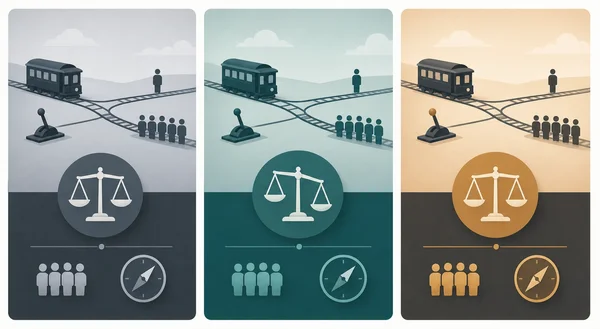
The trolley car problem is one of the most famous ethical thought experiments because it turns a huge moral question into a scene almost anyone can picture. A runaway trolley is heading toward five people. You can pull a lever and divert it, but doing so sends it toward one person instead. Should you act? The question sounds simple, but the reasoning behind each answer can reveal how people weigh harm, duty, intention, responsibility, and uncertainty. If you want to compare this dilemma with your own moral priorities, an ethics self-discovery tool can give you a structured way to reflect without treating any single answer as a final verdict.

What Is the Trolley Car Problem?
In its classic form, the trolley car problem asks whether it is morally acceptable to redirect a runaway trolley so that one person dies instead of five. The standard version is usually linked to philosopher Philippa Foot's 1967 discussion of the doctrine of double effect, although earlier trolley-like cases existed before the modern name became popular.
The point is not just "five is more than one." The dilemma asks whether the way harm happens matters. Is it different to let harm continue than to actively redirect it? Does saving more people justify causing a death? Does the answer change if the person you would harm is a stranger, a loved one, a wrongdoer, or someone who was never in danger until you intervened?
That is why the trolley problem remains useful. It compresses several moral frameworks into one vivid choice. A utilitarian answer tends to focus on the outcome: fewer deaths. A deontological answer tends to focus on duties and limits: do not intentionally cause innocent harm. A virtue ethics answer might ask what a wise, courageous, or just person would do when every option is bad.
Why the Trolley Problem Has No Single Clean Solution
Many people search for a trolley problem solution, but the better answer is that the trolley car problem is not built like a math problem. It is a pressure test for reasoning. The "solution" depends on which moral principle you think should lead when principles collide.
If you prioritize consequences, pulling the lever can look right because it minimizes deaths. If you prioritize a rule against intentional harm, pulling the lever may look wrong because you make one person's death part of your action. If you focus on responsibility, you may ask whether doing nothing is also a choice. If you focus on fairness, you may ask why any person should be selected as the one who pays the cost.
This is also why trolley problem examples can feel frustrating. Small story details change the answer. Pulling a switch usually feels different from pushing a person. Redirecting a trolley toward one worker usually feels different from targeting someone because of their age, social status, health, or identity. The problem shows that our moral judgments are sensitive to intention, proximity, consent, identity, and the difference between foreseen harm and intended harm.
Common Trolley Problem Variations and Arguments
The basic trolley problem is only the first version. Philosophers and teachers often use variations to test whether a person's principle holds up when the scene changes.
In the switch case, you redirect the trolley from five people to one. In the footbridge case, the only way to stop the trolley is to push a person from a bridge. In loop cases, the trolley may return to the original track unless the one person stops it. In absurd trolley problems, the scene becomes intentionally strange: the people may be replaced with pets, villains, robots, copies of yourself, or impossible pop-culture situations. These silly versions can still reveal serious intuitions, but they are usually better for discussion than for policy.
The main trolley problem arguments usually fall into a few families. The utilitarian argument says you should choose the action that produces the least overall harm. The deontological argument says some actions remain wrong even when they improve the final count. The doctrine of double effect says there can be a moral difference between harm that is foreseen as a side effect and harm that is intended as a means. A character-focused argument asks what the decision reveals about courage, compassion, humility, and respect for persons.
None of these frameworks is a perfect shortcut. Each highlights something real and misses something else. That is why the trolley problem works best as a conversation starter, not as a machine that prints the correct answer.
What the Trolley Problem Reveals About Your Moral Compass
The trolley car problem can be useful for personal reflection because it makes hidden priorities visible. Some people notice that they quickly count lives. Others notice that they recoil from direct harm. Some feel that refusing to choose is itself a moral failure. Others feel that forced-choice dilemmas are unfair because they erase the relationships, histories, and responsibilities that usually shape real ethical decisions.
A helpful way to use the question is to ask what your answer is protecting. Are you protecting the greatest number of people? The dignity of each individual? A boundary against using a person as a tool? Your own refusal to become a cause of harm? A public rule that could be applied fairly by others?
This is where the trolley problem connects naturally to moral self-knowledge. A single answer does not define your character, but a pattern of answers can help you explore your moral compass with more precision. You may find that you lean toward outcome-based reasoning in distant scenarios, but toward duty-based reasoning when the action becomes personal. You may also find that your answer changes when the people involved become less abstract.
The Trolley Problem and AI Cars
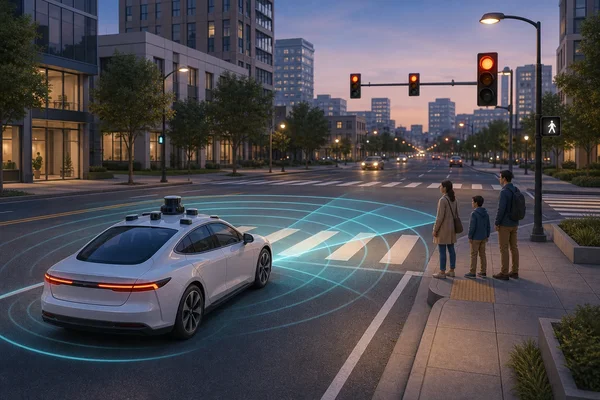
Search interest around the trolley problem often spikes because of self-driving cars. The popular question is whether an autonomous car should sacrifice a passenger to save pedestrians, or protect the passenger at all costs. That sounds like the classic trolley problem, updated with sensors, software, and roads.
The connection is real, but it is easy to overstate. The Moral Machine experiment showed that millions of people across many countries have different preferences about how autonomous vehicles should behave in unavoidable crash scenarios. That research made the public dimension of machine ethics visible: people do not all agree on what a "socially acceptable" decision should be.
At the same time, many engineers and ethicists argue that the classic trolley framing is too narrow for real traffic safety. Self-driving systems are not supposed to wait until an impossible last-second moral riddle appears. Their safety goal is to reduce risk earlier through sensing, prediction, braking, conservative planning, operational limits, road rules, testing, and regulatory oversight. The most important autonomous car ethics questions may be less dramatic than "who should die?" and more practical: What risks are foreseeable? Who is accountable? How transparent should systems be? How should vehicles behave around pedestrians, cyclists, and human drivers? What evidence is enough before deployment?
How to Think Through a Trolley Problem Question
When you meet a trolley problem question, do not rush to sound clever. Slow reasoning is the point. Try this four-step reflection process.
First, name the action. Are you allowing an existing danger to continue, redirecting it, directly harming someone, or creating a new risk? Second, name the moral value you are prioritizing. It might be minimizing deaths, respecting each person, avoiding intentional harm, protecting public trust, or accepting responsibility for action and inaction. Third, test the consistency of your answer. Would you give the same answer if the people changed? If you were one of them? If a public institution used your rule? Fourth, notice your discomfort. The discomfort is not a failure. It is information about the values that are competing.
For classrooms, teams, and AI ethics discussions, it helps to separate the choice from the explanation. Two people may both pull the lever for different reasons. Two people may both refuse for different reasons. The richer discussion is not just what they choose, but why that choice feels morally allowed, required, or forbidden.

What the Trolley Car Problem Can and Cannot Tell You
The trolley car problem can help you notice how you reason under moral pressure. It can clarify why utilitarian, deontological, and virtue-based arguments pull in different directions. It can make AI ethics easier to discuss because it gives people a shared example before moving into harder questions about design, law, bias, accountability, and public trust.
But it cannot tell you whether you are a good or bad person. It cannot settle all legal questions. It cannot replace real-world safety analysis for self-driving cars. It also cannot capture the full texture of ordinary moral life, where people have relationships, histories, obligations, limited information, and time to prevent harm before a crisis becomes binary.
Use the trolley problem as a mirror, not a verdict. If it leaves you curious about your broader values, structured ethical reflection can help you compare one dramatic dilemma with the more ordinary patterns in your decision-making.
FAQ
Is there an answer to the trolley problem?
There is no single universally accepted answer. A utilitarian answer often says to pull the lever because one death is less harmful than five. A deontological answer may say not to pull it because intentionally redirecting harm toward an innocent person crosses a moral line. Other approaches focus on character, responsibility, consent, or public rules. The value of the trolley problem is that it exposes the reasoning behind the answer.
How do people with psychopathic traits respond to the trolley problem?
Research on psychopathic traits has sometimes found a stronger tendency toward utilitarian responses in sacrificial moral dilemmas, especially when the task measures willingness to endorse instrumental harm. That does not mean a single trolley answer identifies someone as a psychopath. Moral dilemma studies examine patterns, traits, and task designs; they should not be used as personal labels.
Who first posed the trolley problem?
The modern trolley problem is most often credited to Philippa Foot, who discussed the runaway trolley case in 1967 while analyzing the doctrine of double effect. Judith Jarvis Thomson later developed influential variations, including the footbridge case, and helped make the trolley problem a major subject in moral philosophy.
What does the law say about the trolley problem?
Law does not give one simple trolley problem answer. Legal systems often distinguish between action and omission, intention and foresight, necessity and liability, and criminal law and negligence rules. In real cases, facts and jurisdictions matter. For autonomous vehicles, legal discussion usually focuses less on a single lever choice and more on safety standards, accountability, regulation, and whether systems reduce risk compared with human driving.
Is the trolley problem useful for self-driving car ethics?
It is useful as a teaching tool and as a way to introduce machine ethics, but it is limited. Real autonomous vehicle safety depends on preventing dangerous situations, defining responsibility, testing systems, following traffic rules, and reducing foreseeable risk. A self-driving car ethics framework should not be built only around rare last-second sacrifice scenarios.
What are absurd trolley problems?
Absurd trolley problems are exaggerated or playful variations of the classic dilemma. They might add strange characters, impossible numbers, fictional machines, or comic twists. They can be fun and revealing, but they should be treated carefully. The more absurd the setup becomes, the less it can tell us about real-world ethics, law, or engineering.