The Trolly Car Problem Case Explained: What the Trolley Problem Reveals About Moral Choice
People often search for "the trolly car problem case" when they mean the classic trolley problem: a runaway trolley is heading toward five people, and you can pull a lever to divert it onto another track where one person will die instead. The spelling may vary, but the moral pressure is the same. Do you act and become involved in one death, or do you stand back and allow five deaths? This article explains the case, the main answers, why it remains controversial, and how it can help you reflect on your own values. For readers who want a broader way to examine ethical instincts, moral self-reflection tools can make the question less about winning an argument and more about noticing how you reason.
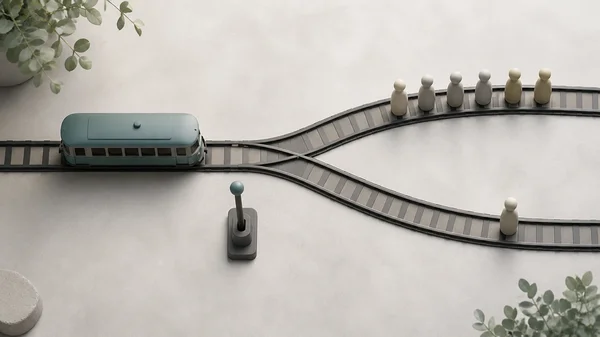
What the "Trolly Car Problem Case" Actually Means
The trolley problem is a thought experiment in moral philosophy and moral psychology. It is not usually a report of one real incident. Instead, it is a simplified case designed to isolate a difficult question: may you harm one person as a way to prevent greater harm to several others?
The basic version is sometimes called the switch case. A trolley is moving toward five people on the main track. You are near a switch. If you do nothing, the five people die. If you pull the switch, the trolley moves to a side track and one person dies. The case asks whether pulling the switch is morally required, allowed, wrong, or impossible to judge without more context.
The value of the case is not that it gives an easy answer. Its value is that it exposes the principles people reach for under pressure: outcomes, duties, intentions, fairness, responsibility, emotional distance, and the difference between doing harm and allowing harm.
The Classic Trolley Problem Question
The classic trolley problem question is simple enough to state in one sentence: should you pull the lever to save five people if doing so causes one person to die?
A consequence-focused answer says yes. Five lives saved and one life lost is a better outcome than five lives lost. From this view, refusing to act can look like choosing the worse result.
A duty-focused answer is more hesitant. It may say that deliberately redirecting danger toward an uninvolved person crosses a moral boundary, even if the numbers improve. From this view, human lives should not be treated as items in a calculation.
A responsibility-focused answer asks what role you occupy. Are you a bystander, a driver, an engineer, a public official, or someone who created the danger? The same physical action can feel different depending on whether you are preventing harm, distributing harm, or using one person as a means to protect others.
This is why "the answer" to the trolley problem is rarely just yes or no. A better answer usually explains which moral principle is doing the work.

Why the Same Case Produces Different Answers
The trolley problem feels unstable because small changes in the story can change people's judgments. Pulling a distant lever often feels different from physically pushing someone into danger. Redirecting an existing threat feels different from creating a new threat. Saving strangers can feel different from saving family members.
Consequences: save the greater number
The most familiar trolley problem solution is utilitarian in spirit: choose the action that minimizes total harm. If one death is unavoidable in the lever case, and pulling the lever saves four net lives, the action may appear morally better than doing nothing.
This approach has real strengths. It forces people to take preventable suffering seriously. It also keeps moral reasoning from becoming only about personal comfort. If refusing to act protects your clean conscience while five people die, the consequence-focused critic will ask whether that is really moral restraint.
Its weakness is that it can sound too arithmetic. Most people hesitate to say that one person may always be sacrificed whenever a larger group benefits. The trolley problem becomes controversial when "save more lives" starts to look like permission to override individual rights.
Duties: do not use a person as a tool
A duty-based response asks whether the one person on the side track has been turned into a means to an end. The person is not just a number. They have a claim not to be intentionally harmed, even in a tragic situation.
This is one reason the footbridge variation provokes stronger resistance. In that version, a large bystander could be pushed from a bridge to stop the trolley and save five people. Many people who accept pulling the lever reject pushing the person. The outcome may look similar, but the action feels morally different because the person's body becomes the instrument of the rescue.
Intention: killing, letting die, and side effects
The trolley problem also raises the difference between killing and letting die. If you do nothing, five people die from a threat already moving toward them. If you pull the lever, one person dies because you redirected the threat. Some people see that as a morally relevant difference. Others argue that when you can prevent five deaths at the cost of one, inaction is still a choice.
The doctrine of double effect is often discussed here. In plain terms, it asks whether a bad effect is intended as part of the plan or merely foreseen as a side effect. In the switch case, someone may argue that the intention is to save five, while the one death is a tragic side effect. In the footbridge case, the death of the pushed person seems to be part of the method. That distinction does not solve every version, but it explains why similar numbers can feel morally different.
Trolley Problem Examples and Variations
Trolley problem examples are useful because each variation tests a different piece of your moral reasoning.
In the switch case, you can redirect the trolley from five people toward one. This tests how much weight you give to outcomes and whether you see redirecting harm as different from causing harm.
In the footbridge case, you can push one person into the trolley's path to stop it. This tests whether direct physical involvement changes your judgment.
In the loop case, the side track loops back toward the five, but the one person would stop the trolley before it returns. This tests whether the one person's death is a side effect or part of the rescue mechanism.
In the loved-one variation, the one person on the side track is someone close to you. This tests whether impartial moral rules survive personal attachment.
In trolley problem games and classroom exercises, the case may be made more absurd or playful. That can make the dilemma easier to discuss, but it can also hide the seriousness of the underlying question. A game may ask for a fast choice; ethical reflection asks what your choice reveals and what principle you would be willing to defend.

Is There a Trolley Problem Solution?
There is no single trolley problem solution that settles every version. There are better and worse explanations, and there are answers that fit some cases more clearly than others.
A strong answer usually does three things. First, it states the action: pull the lever, do not pull it, or refuse to answer without more facts. Second, it names the principle: reducing harm, respecting rights, avoiding intentional killing, honoring duties, or preserving fairness. Third, it admits the cost of that principle. If you pull the lever, you accept responsibility for redirecting danger. If you do not pull it, you accept that five people die when you might have reduced the harm.
That is where an ethical decision-making framework can be helpful. Not because it hands you a universal answer, but because it encourages you to separate the pressure of the scenario from the values underneath your response.
For many readers, the best answer is not "I solved it." It is "I can explain why I lean this way, what I am protecting, and what still troubles me."
Why the Trolley Problem Is So Controversial
The trolley problem is controversial because it compresses human life into a clean little diagram. Real moral choices usually include uncertainty, relationships, history, law, power, consent, and the possibility of alternatives. The trolley case strips most of that away. That makes it useful for analysis, but also dangerously neat.
Critics argue that it can train people to overvalue abstract calculation. If every hard choice becomes a trolley case, then ethics can start to look like choosing who should suffer. In real life, the first moral task is often to prevent the tracks from being built that way in the first place.
The case is also controversial because it reveals disagreement about moral responsibility. Some people feel that standing aside is passive and therefore less blameworthy. Others think that once you understand the consequences, standing aside is morally active. The disagreement is not only about the lever. It is about what it means to be responsible when every available option is tragic.
Trolley Problem AI and Modern Decision-Making
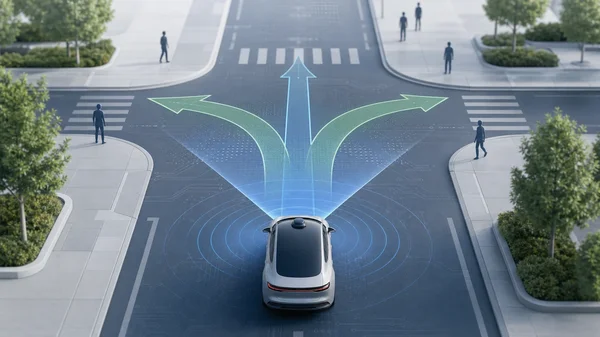
The phrase "trolley problem AI" usually refers to debates about autonomous vehicles, machine learning systems, and automated decisions in high-risk settings. People ask whether a self-driving car should be programmed to protect passengers, pedestrians, the greater number, or whoever is least at fault.
The trolley problem is a useful entry point for those debates, but it should not be treated as the whole problem. Real vehicles do not usually face perfectly labeled choices between one person and five people. They face sensor limits, braking distance, road design, speed, uncertainty, and legal standards. Good AI ethics should focus less on dramatic sacrifice puzzles and more on reducing foreseeable risk before a crisis occurs.
Still, the trolley problem remains relevant because it shows how values can be hidden inside design choices. A system that optimizes only for total numbers may miss fairness and rights. A system that avoids all explicit tradeoffs may hide tradeoffs in technical defaults. The lesson is not that AI should "solve" the trolley problem. The lesson is that moral assumptions should be visible, discussed, and accountable.
How to Use the Trolley Problem for Moral Self-Reflection
The best use of the trolly car problem case is not to label yourself as good, bad, brave, cold, rational, or emotional. It is to slow down and ask better questions about your moral pattern.
Try this short reflection process. First, answer the switch case quickly. Would you pull the lever? Second, write one sentence explaining why. Third, test your reason against a variation: footbridge, loved one, loop track, or AI vehicle. Fourth, notice what changed. Was it physical closeness, intention, consent, fairness, emotional attachment, or distrust of calculation?
You can also ask: what value am I protecting when I answer this way? Am I protecting the greatest number, the dignity of the one, my duty not to kill, the importance of impartiality, or the need for human relationships to matter?
For a low-pressure next step, exploring your personal moral compass can help connect this one famous dilemma to broader patterns in your ethical judgment. The point is not to turn a thought experiment into a verdict. The point is to make your reasoning more visible, more humble, and more open to careful discussion.

FAQ
What's the best answer to the trolley problem?
The best answer is one that clearly states both your choice and your principle. A utilitarian answer usually pulls the lever to reduce total deaths. A duty-based answer may refuse to intentionally redirect danger toward an uninvolved person. A strong response also admits the moral cost of the path it chooses.
Why is the trolley problem so controversial?
It is controversial because it turns life-and-death ethics into a simplified forced choice. Supporters value its clarity. Critics worry that it removes context, relationships, uncertainty, and prevention, making moral judgment seem more mechanical than it really is.
Is the trolley incident real?
The standard trolley problem is not usually treated as a real historical incident. It is a thought experiment. Similar real-world debates can arise in medicine, war, public safety, and technology, but those situations contain details that the classroom version leaves out.
What was Philippa Foot's answer to the trolley problem?
Philippa Foot used the trolley-style case to examine moral distinctions such as doing harm, allowing harm, and the difference between negative and positive duties. Her discussion helped frame why diverting a threat may seem different from directly killing an innocent person to produce a better outcome.
Why do people answer the lever case and footbridge case differently?
Many people see pulling a lever as redirecting an existing threat, while pushing a person feels like using that person as the method of rescue. The numbers may be similar, but intention, physical involvement, and personal force change the moral feel of the case.
How does the trolley problem apply to AI?
It applies as a warning more than a complete model. AI systems can hide moral tradeoffs in design choices, especially in high-risk settings. But real systems involve uncertainty, prevention, law, and engineering constraints, so ethical design should not rely only on dramatic trolley-style puzzles.