Political Map Compass: How to Read Ideology Without Flattening Your Values
A political map compass is a simple picture with a complicated job: it tries to show political beliefs as a position on a map instead of as a single label. That can be useful when "left" and "right" feel too flat, but it can also create false confidence if you treat one dot as your whole worldview. A better use is reflective. Read the axes, notice the tradeoffs behind each quadrant, then compare the map with your moral priorities. If you want a nonpartisan way to think about values before turning them into political labels, an ethical self-reflection tool can help you separate your moral instincts from the labels people use in debate.

Political Compass Explained in Plain English
The classic political spectrum puts views on one line. The left side is usually associated with more support for equality, redistribution, public services, labor protections, or collective responsibility. The right side is usually associated with market freedom, private property, tradition, limited government in economic life, or hierarchy as a natural feature of society. That line is familiar, but it compresses too much into one dimension.
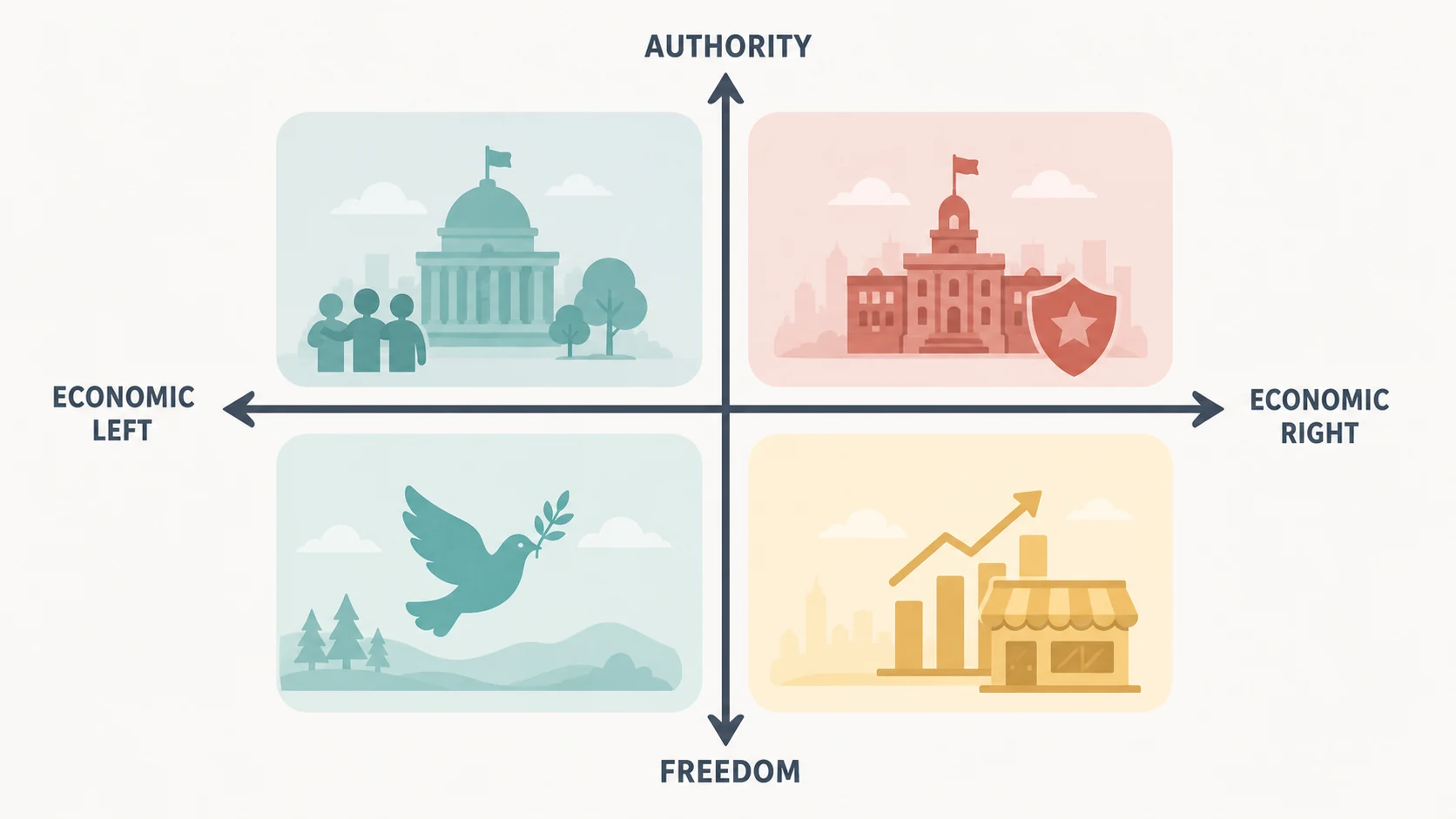
A political compass adds a second axis. The horizontal axis still describes economic left versus economic right. The vertical axis asks a different question: how much authority, hierarchy, order, personal liberty, or social freedom should a society prioritize? In many versions, the top is more authoritarian and the bottom is more libertarian. This is why a person can be economically left but socially authoritarian, economically right but socially libertarian, or somewhere in the center on both.
This is also why the phrase "political map compass" matters. You are not only asking, "Am I right or left?" You are asking, "Which values pull my views in different directions?" A map is more honest than a label when your views on taxes, speech, religion, policing, welfare, immigration, and personal freedom do not all line up neatly.
What the Four Quadrants Usually Mean
Most blank political compass charts divide the map into four broad quadrants. These are not fixed identities, and they are not moral grades. They are regions that help you describe patterns.
The upper left is often called authoritarian left. It combines support for more economic equality or state planning with stronger centralized authority, social order, or collective discipline. The lower left is usually libertarian left. It combines egalitarian economics with stronger emphasis on civil liberties, decentralization, personal autonomy, or anti-authoritarian culture.
The upper right is commonly authoritarian right. It combines market-oriented or hierarchical economic views with stronger support for national order, tradition, security, or centralized authority. The lower right is libertarian right. It combines market-oriented economics with stronger support for personal liberty, limited state power, and individual choice.
Real political compass ideologies are messier than these four boxes. A social democrat, democratic socialist, green libertarian, religious conservative, classical liberal, nationalist conservative, anarchist, or technocrat may not fit perfectly. People also change positions by issue. Someone may be libertarian on speech, authoritarian on crime, left-leaning on health care, and right-leaning on business regulation.
Why a Map Beats Left vs Right, but Still Has Limits
The benefit of a political map is that it reveals cross-pressure. Pew's political typology work, for example, shows that many people do not sort into only two ideological camps. Some voters are economically populist but socially conservative. Others are socially liberal but cautious about institutions, crime, or immigration. Some people are highly ideological, while others are mixed, disengaged, or pragmatic. A two-axis map helps readers see why political coalitions are not as simple as red versus blue.
The limit is that a compass can look more scientific than it really is. A test result depends on the questions, scoring model, cultural assumptions, and the way each axis is defined. A political compass test free of payment is not automatically better or worse than a paid or academic survey. The best political compass test is one that explains its methodology, avoids manipulative wording, and treats results as a starting point for thought.
This is especially important when people search for a political compass test IDRlabs, a Pew Research political quiz, an I Side With quiz, or another political alignment test. Each tool measures a slightly different thing: policy agreement, ideology, party fit, or chart placement. None can fully capture the reasons you hold a belief.
How to Read Your Dot Without Overreading It
Start with the axes, not the label. If your dot is left of center, ask whether that reflects economic equality, skepticism of corporate power, support for welfare programs, or something else. If your dot is right of center, ask whether that reflects market preference, property rights, tradition, fiscal caution, or distrust of state planning.
Then read the vertical position. A higher position may mean stronger comfort with authority, order, hierarchy, national cohesion, or rule enforcement. A lower position may mean stronger preference for personal freedom, decentralization, pluralism, civil liberties, or voluntary association. But do not treat "high" as automatically cruel or "low" as automatically virtuous. Every value can be wise in one context and risky in another.
Next, look at distance from the center. A far-corner result often means your answers were consistent in one direction, but it does not mean you are extreme in everyday behavior. It may also mean the questions forced choices that felt narrower than your real views. If a result surprises you, reread the questions that drove it. The useful question is not "What label did I get?" but "Which tradeoffs did I accept without noticing?"
This is where moral reflection matters. Political views are often downstream of moral priorities: fairness, liberty, loyalty, authority, care, responsibility, sanctity, honesty, and harm avoidance. A Moral Foundations-style reflection can give you a vocabulary for those priorities before you turn them into party labels or candidate choices.
Using a Blank Political Compass for Better Thinking
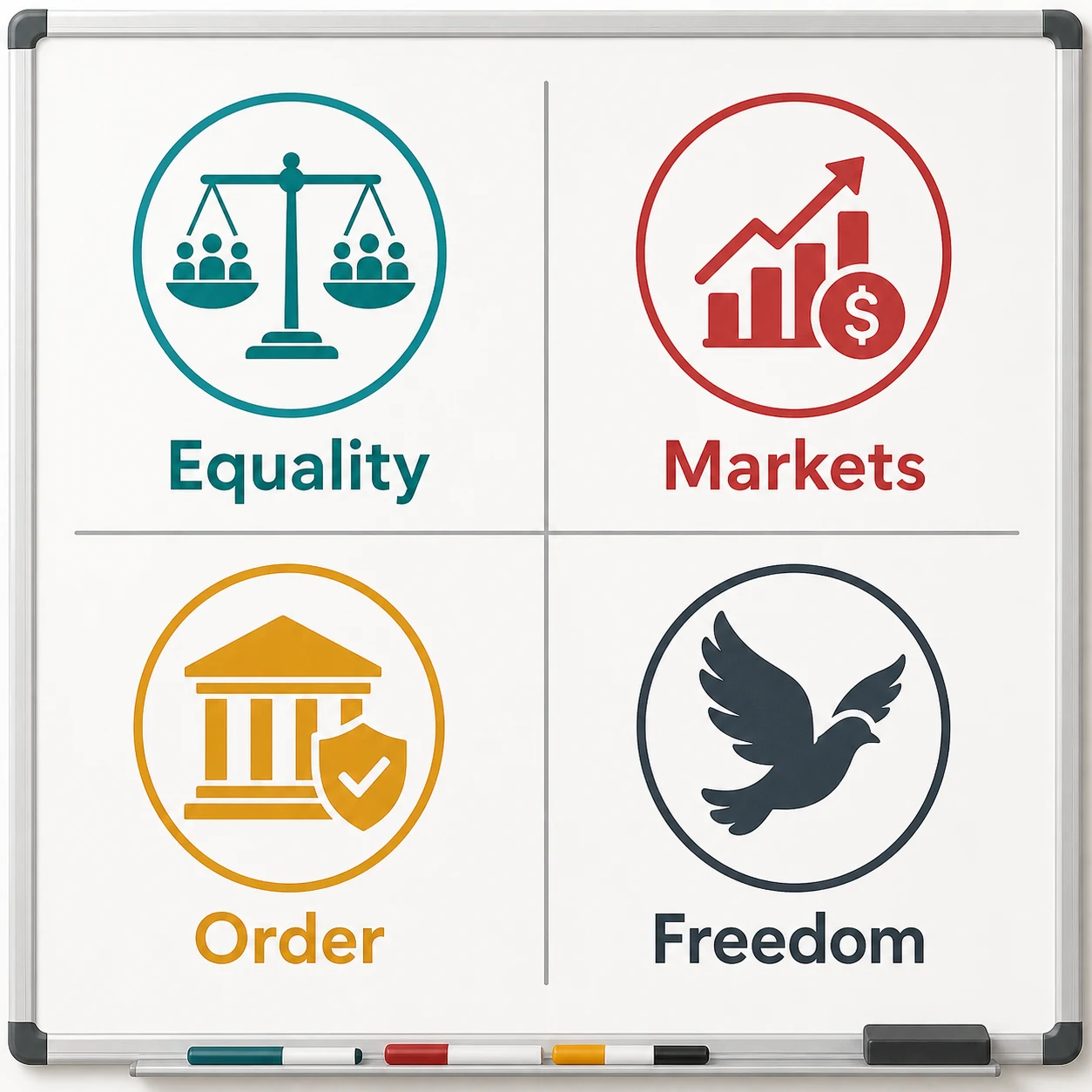
A blank political compass can be more useful than a quiz result because it slows you down. Draw the two axes. Then place issues instead of people. Put taxation, climate policy, policing, speech, school choice, immigration, health care, foreign policy, and digital privacy where you think they belong. You may discover that your issue map is scattered.
That scattered pattern is not a failure. It can show that your beliefs are built from several values rather than from one team identity. For instance, a person might put universal health care on the economic left, strong privacy protections near the libertarian side, tough anti-corruption enforcement toward the authority side, and small-business deregulation on the economic right. The map becomes a conversation with yourself.
You can also use a blank political compass to compare political compass countries, but carefully. Countries are not single minds. A national placement is usually an approximation based on institutions, parties, or survey averages, not a complete portrait of the people who live there.
Political Labels, Public Figures, and Common Search Questions
Searchers often want fast answers about famous people or groups. Those answers should be handled with humility.
Liberals usually fall on the left side of the political compass in U.S. political language, especially on economic or social equality questions. Many liberals also score lower on the authoritarian-libertarian axis when civil liberties and personal autonomy are emphasized. But liberalism is a broad family, and some liberals support stronger state action in areas such as regulation, public health, or anti-discrimination enforcement.
Bernie Sanders is commonly described as left-wing or democratic socialist in U.S. politics. On many political compass charts, he is likely to appear left of center economically. His vertical placement depends on the test's questions and how it weighs civil liberties, government power, and social policy. Treat any exact coordinate as a model's claim, not a settled fact.
Donald Trump is generally described in U.S. politics as right-wing, conservative, and Republican. Some compass-style interpretations place Trump to the right economically and higher on the authority axis because of his emphasis on borders, policing, executive power, national identity, and political conflict. Again, exact placement depends on methodology, and a chart should not replace careful issue-by-issue analysis.
The left side of the political compass generally means more support for equality, redistribution, labor power, public provision, or collective economic responsibility. It does not automatically mean socially liberal, anti-market in every respect, or supportive of every left party. The map is a vocabulary, not a verdict.

From Political Map Compass to Moral Compass
A political map compass is most useful when it sends you back to values rather than trapping you inside a quadrant. After you read a result, ask three questions. Which issues pulled me farthest from the center? Which tradeoffs felt uncomfortable? Which values would I defend even if my preferred party or group ignored them?
That final question is the bridge between political identity and moral identity. Politics asks how society should share power, risk, money, rights, duties, and recognition. Morality asks why those things matter to you. If your political compass result feels incomplete, use it as a prompt for deeper reflection, not as a permanent identity badge.
MoralTest.org is built for that kind of reflective step. Its 48-question Moral Foundations approach is not a political party quiz and does not rank people as better or worse. It helps you explore moral inclinations, ethical frameworks, and decision-making patterns. If a political map compass tells you where your policy instincts cluster, a guided ethics profile can help you think about the values underneath those instincts.
FAQ
What is a political map compass?
A political map compass is a two-axis chart that places political views on a map. The horizontal axis usually describes economic left versus economic right, while the vertical axis usually describes authoritarian versus libertarian tendencies. It is useful for explaining why political beliefs do not always fit a simple left-right line.
What does the left side of the political compass mean?
The left side usually points toward economic equality, redistribution, labor rights, public services, or collective responsibility. It does not automatically tell you a person's views on speech, religion, policing, culture, or personal freedom. Those are often shown on the vertical axis or handled issue by issue.
Where do liberals fall on the political compass?
In U.S. language, liberals usually fall left of center, especially on equality, welfare, regulation, and civil rights issues. Many also lean libertarian on personal autonomy and civil liberties. However, liberal views vary, and some liberals support stronger state authority in specific policy areas.
Is Donald Trump right or left?
Donald Trump is generally described as right-wing, conservative, and Republican in U.S. politics. Compass-style charts may place him on the economic right and toward the authority side, but exact coordinates depend on the model and questions used. It is better to compare specific policy positions than rely on one dot.
Where is Bernie Sanders on the political compass?
Bernie Sanders is commonly described as left-wing or democratic socialist in U.S. politics, so most compass-style interpretations place him left of center economically. His vertical position varies by methodology because tests weigh civil liberties, state power, and social policy differently.
Is a blank political compass better than a quiz?
A blank political compass is better for reflection because you decide where issues belong and explain your reasoning. A quiz is faster and can reveal patterns, but it depends on question wording and scoring. The strongest approach is to use both: take a result seriously enough to examine it, but not so seriously that it replaces judgment.
Can a political compass show countries accurately?
Only roughly. Political compass countries charts often simplify national institutions, party systems, public opinion, and regional differences into a single placement. They can be useful for comparison, but they should be treated as broad models rather than exact portraits.