Master Your Moral Compass: Self-Assessment Guide
Have you ever found yourself in a tough situation, wondering why you made a particular choice? Or perhaps you've asked yourself, "What truly guides my sense of right and wrong?" Understanding your inner moral compass is a journey of self-discovery. This journey helps you navigate life’s complex ethical challenges with greater confidence and clarity.
This guide provides practical self-assessment techniques to help you map your ethical landscape. We will explore how to identify your core values, analyze your decision-making patterns, and use simple exercises to build stronger self-awareness. While these methods are powerful, supplementing them with a structured tool can offer even deeper insights. At Moraltest.org, our free, AI-driven moral test is designed to give you a comprehensive look at your ethical profile.

This guide will help you build a clear framework for ethical self-assessment, empowering you to navigate life's moral challenges with confidence. You'll learn how to master your moral compass and make choices that align more closely with who you truly are.
Understanding Your Ethical Decision-Making Patterns
The first step in mastering your moral compass is to understand the patterns that already exist in your decision-making. We all have default responses to ethical dilemmas, often shaped by our upbringing, experiences, and core beliefs. Recognizing these patterns is crucial for intentional personal growth.
Think of it like being a detective of your own mind. You are looking for clues that reveal the underlying logic of your choices. This process isn't about judging your past actions as "good" or "bad." Instead, it's about gaining the awareness needed to make more conscious and aligned decisions in the future.
Identifying Your Moral Triggers and Values
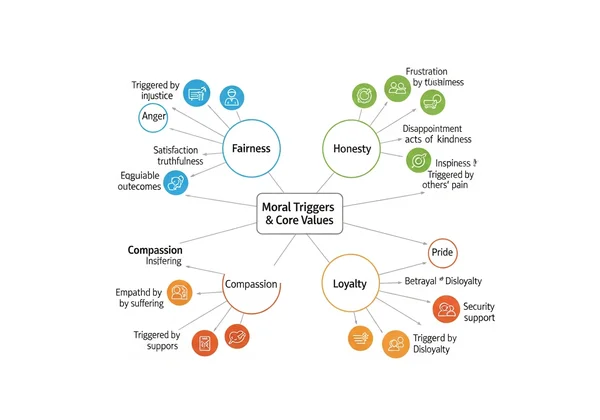
Your moral triggers are the situations or ideas that cause a strong emotional or ethical response in you. For example, witnessing an act of unfairness might trigger a feeling of anger, while an act of kindness might inspire you. These reactions are signposts pointing toward your deeply held values.
To identify them, start by reflecting on recent events.
- What situations made you feel proud, angry, or disappointed?
- What principles were at play? Was it honesty, loyalty, fairness, or something else?
- Write these values down. Seeing them on paper helps solidify your understanding of what truly matters to you.
This simple act of observation is the foundation of any meaningful ethical self-assessment guide. It turns abstract feelings into concrete principles you can work with.
Recognizing Your Default Ethical Frameworks
While you may not use academic terms, you instinctively use ethical frameworks to make decisions. Some people prioritize outcomes (consequentialism), asking "What will create the greatest good?" Others focus on duties and rules (deontology). They believe that certain actions are inherently right or wrong, regardless of the result.
Do you tend to follow the rules, no matter what? Or are you more likely to bend a rule if it leads to a better outcome for everyone involved? Recognizing your default approach helps you see its strengths and potential blind spots. Understanding this default is a key step to analyze moral decisions with more objectivity.
Journaling Exercises for Moral Self-Reflection
Journaling is a powerful and private way to explore your moral world. It creates a space for honest reflection without the pressure of outside judgment. Committing your thoughts to paper can reveal patterns and insights that might otherwise remain hidden. These values journaling exercises are designed to be simple yet profound.
The goal isn't to write a perfect essay. It's to have a conversation with yourself. Be curious, be honest, and allow your thoughts to flow freely. This practice helps you connect with your inner ethical voice and strengthen your moral awareness over time.
Setting Up Your Moral Decision Journal
Starting your journal is easy. All you need is a notebook or a digital document. Dedicate it specifically to your moral reflections to maintain focus. To begin, create a simple structure you can use regularly.
Consider these columns or sections for each entry:
- The Dilemma: Briefly describe an ethical challenge you faced, whether large or small.
- My Action: What did you do or say in that situation?
- The Feelings: How did you feel before, during, and after the decision?
- The Values: Which of your core values were in conflict or at play?
- The Reflection: Looking back, what would you do differently? What did you learn about yourself?
This structured approach provides a clear framework for your thoughts, making it easier to see patterns emerge over time.

Analyzing Past Ethical Dilemmas Through Writing
Once your journal is set up, look back at a past ethical dilemma. It could be a difficult choice you made at work, a conflict with a friend, or even a reaction to a news story. Write about it using the structure you created. Don't censor yourself; describe the situation and your feelings as you remember them.
As you write, ask yourself probing questions. Why did I prioritize one value over another? Was I influenced by fear, peer pressure, or a desire for a specific outcome? This exercise is not about reliving regret. It is a tool for learning. By dissecting your past choices in a safe space, you prepare yourself to handle future challenges with greater wisdom.
Evaluating Real-Life Moral Scenarios
Theory is helpful, but applying it to real-life scenarios makes it practical. By analyzing hypothetical and personal situations, you can test your ethical frameworks and see how they hold up under pressure. This process is like a workout for your moral muscles, making them stronger and more flexible.
This practice helps you move from simply reacting to situations to responding with intention. When you regularly analyze moral decisions, you become better equipped to handle unexpected ethical challenges in your personal and professional life. This skill is invaluable for anyone committed to personal integrity.
The 5 Core Values Framework for Scenario Analysis
When faced with a dilemma, you can use a simple framework to guide your thinking. While moral philosophy outlines many values, a common approach is to consider five core domains that often appear in human ethics. Think of them as lenses through which you can view a problem.
- Care/Harm: Does this action cause suffering or promote well-being?
- Fairness/Cheating: Is this action just and equitable for all involved?
- Loyalty/Betrayal: Does this action honor my commitments to my group or community?
- Authority/Subversion: Does this action respect legitimate rules and traditions?
- Sanctity/Degradation: Does this action treat things with reverence or debase them?
Using these five lenses helps ensure you consider a problem from multiple angles, preventing you from getting stuck in a single point of view. For a more detailed breakdown based on scientific research, you can start your test to see how you score across these foundations.
Creating Personalized Case Studies
To make this exercise even more powerful, create case studies based on your own life. Think about recurring challenges you face at work, in your family, or in your community. Write them down as short, third-person scenarios.
For example: "A manager is asked to implement a new policy they believe is unfair to their team. What should they do?" By framing your personal challenge as a case study, you can analyze it with more objectivity. Apply the 5 Core Values Framework to this scenario. What conflicts arise? This technique helps you prepare for future situations, so you can act from a place of principle, not panic.
Your Next Steps in Ethical Self-Discovery
Through these techniques—identifying your values and analyzing complex scenarios—you're developing a powerful toolkit for ethical self-discovery. Mastering your moral compass is not a one-time event; it is an ongoing practice of reflection and growth. By consistently engaging in these exercises, you build the self-awareness needed to live a more principled and fulfilling life.
These manual methods provide a fantastic foundation. However, to truly accelerate your journey, a scientifically designed tool can offer insights that are difficult to uncover on your own. It can reveal hidden biases and connect your choices to established psychological frameworks, giving you a comprehensive map of your ethical self.
Ready to see the full picture? The techniques in this guide are a great start. When you're ready to go deeper, take the next step. Our platform provides a free, confidential, and in-depth analysis of your unique moral profile. Start your free moral test today and discover your ethical core.

FAQ Section
How do I figure out my morals and values?
Start by paying attention to your emotional reactions. The situations that make you feel proud, angry, or inspired are clues to your core values. Try the journaling exercises mentioned in this guide: write down past dilemmas and identify which principles (like honesty, compassion, or fairness) were at play. Consistent self-reflection is the key to clarifying what matters most to you.
What are the 5 core moral values I should consider?
A useful framework for analyzing ethical problems involves five core value domains: Care/Harm (kindness and compassion), Fairness/Cheating (justice and rights), Loyalty/Betrayal (group solidarity), Authority/Subversion (respect for tradition and order), and Sanctity/Degradation (purity and reverence). Considering a problem through these five lenses helps you make a more well-rounded decision.
How can a professional test enhance my self-assessment?
While self-reflection is essential, a professional test like the one at Moraltest.org offers unique advantages. It uses scientifically validated questions and a sophisticated algorithm to compare your responses to established ethical frameworks. This provides objective, data-driven insights that are free from your personal biases. It can highlight blind spots and offer a detailed, personalized report that turns your abstract feelings into actionable knowledge. To supplement your journaling, try our free tool.