Chaotic Good Chart: Meaning, Examples, and a Simple Template
A chaotic good chart is a simple way to place characters, choices, or creative examples on the familiar 3x3 moral alignment grid. The “good” side asks whether a person or character tries to protect others, reduce harm, and act with compassion. The “chaotic” side asks how much they distrust rigid systems, rules, or authority when those rules get in the way. That makes chaotic good one of the most misunderstood squares: it is not random behavior with a kind heart, and it is not permission to do anything in the name of a cause. The chart can support ethical self-reflection tools by turning vague moral instincts into clearer language.
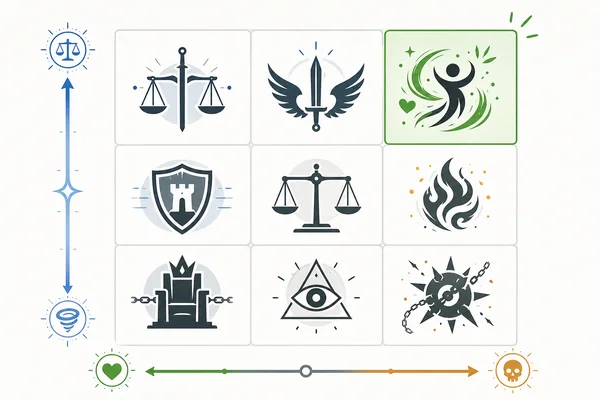
What a Chaotic Good Chart Shows
The alignment chart usually has two axes. One axis runs from lawful to chaotic, describing a relationship to rules, institutions, traditions, and authority. The other runs from good to evil, describing whether actions are oriented toward helping others, exploiting others, or staying morally mixed. When those axes cross, they produce nine broad categories.
In the most common layout, chaotic good sits in the top-right square: high on concern for others, low on deference to rules for their own sake. A chaotic good person or character may break a rule, ignore a chain of command, expose a harmful system, or improvise outside official channels. The key is motive and effect. The “chaotic” half is about independence from rigid order. The “good” half is about care, protection, mercy, and a desire to improve someone else’s situation.
For readers who are used to moral foundations language, a chaotic good chart can be read alongside a broader moral values framework. Alignment is a storytelling shorthand, while moral foundations ask more detailed questions about care, fairness, loyalty, authority, sanctity, and liberty. The two systems are not interchangeable, but comparing them can make your interpretation more thoughtful.
The nine moral alignments in one grid
| Alignment | Basic reading |
|---|---|
| Lawful Good | Helps others through duty, order, and principled rules. |
| Neutral Good | Helps others, but chooses rules or flexibility case by case. |
| Chaotic Good | Helps others through freedom, conscience, and resistance to harmful rules. |
| Lawful Neutral | Prioritizes systems, codes, procedure, or order. |
| True Neutral | Avoids strong commitment to either axis or balances competing forces. |
| Chaotic Neutral | Prioritizes freedom, impulse, or independence without a steady helping motive. |
| Lawful Evil | Uses order, rules, or hierarchy to exploit or control. |
| Neutral Evil | Pursues self-interest or harm without a strong law-or-chaos preference. |
| Chaotic Evil | Rejects restraint while causing harm, destruction, or fear. |
This grid separates two questions people often blur together: “Is the action kind?” and “Is the action rule-following?” A character can obey the law and still be cruel. Another can violate a rule and still act from compassion. The chaotic good square exists for that second possibility.

Chaotic Good Meaning: Freedom Plus Care
Chaotic good means acting from conscience when rules, customs, or authorities seem too slow, too narrow, or too unjust. A chaotic good character is often independent, quick to improvise, and suspicious of systems that protect themselves more than people. They may be generous, brave, funny, restless, or difficult to manage. Their moral center is not obedience. It is the belief that people deserve freedom and help, especially when institutions fail them.
That does not mean chaotic good is automatically wise. A well-written chaotic good character can be inspiring and frustrating. They may rush into a rescue before asking whether the plan will work. They may hide information because they distrust the process. They may treat every rule as an obstacle, even when some rules protect vulnerable people. The best chaotic good chart examples show both courage and the risk of acting without enough coordination.
Chaotic good vs chaotic neutral
Chaotic good and chaotic neutral both value freedom. The difference is what freedom is for. Chaotic good uses freedom to protect, liberate, or help. Chaotic neutral uses freedom primarily to preserve personal independence, follow curiosity, or avoid being controlled. A chaotic neutral character may still do good things, but those actions are less consistently guided by care for others.
Try this test when placing a character: if nobody were watching, and no reward were available, would the character still take a personal risk to prevent harm? If yes, chaotic good becomes more plausible. If the character helps only when it is exciting, convenient, or personally useful, chaotic neutral may fit better.
Chaotic good vs neutral good
Neutral good also aims to help, but it is more willing to use whatever path seems most effective. A neutral good character may work within a system, negotiate with authorities, or break a rule only when the situation demands it. Chaotic good is more instinctively skeptical of the system itself. It sees rules as tools at best and barriers at worst.
The difference is subtle. Neutral good asks, “What method will help most?” Chaotic good asks, “Who is being held back, and what freedom do they need?” Both can be compassionate. The chart separates their relationship to order.
Chaotic Good Chart Examples Without Turning It Into a Verdict
The safest way to use a chaotic good chart is with fictional characters, role-playing choices, classroom scenarios, or light cultural examples. A classic chaotic good archetype is the outlaw hero who steals from a corrupt power structure to protect ordinary people. In modern fandom charts, people often debate vigilantes, rebels, hackers, smugglers with a conscience, tricksters who defend the vulnerable, or leaders who ignore orders to save lives.
Those debates are fun because alignment is interpretive. A Marvel, Game of Thrones, anime, or fantasy character may shift across the chart depending on the season, writer, scene, or version you choose. One fan might focus on motive, another on consequences, and another on personal code. Good chart-making names those criteria instead of pretending the square is beyond dispute.
For real people, especially living public figures, the chart becomes much less reliable. It is better to discuss specific actions, public decisions, or stated values than to label a whole person as one alignment. An alignment chart is a lens, not a moral sentence. It can help people talk about patterns, but it should not flatten a complex life into one square.
A quick placement checklist
Before you put someone or something in the chaotic good square, ask:
- Does the action aim to help, protect, free, or reduce harm for others?
- Does the character resist rules because the rules are harmful, not merely inconvenient?
- Would the character accept personal cost for the good outcome?
- Are other people’s freedom and safety respected, not just the character’s own freedom?
- Is the pattern consistent enough to describe, even if the character has messy moments?
If most answers are yes, chaotic good is a strong candidate. If the character mainly loves disorder, attention, or personal freedom, look at chaotic neutral. If the character is compassionate but usually works through accepted channels, look at neutral good or lawful good.

How to Make a Chaotic Good Chart Template
A chaotic good chart template works best when it does more than copy nine labels into boxes. The goal is to make your criteria visible, so viewers can understand why each example landed where it did.
Start with a clean 3x3 grid. Put lawful, neutral, and chaotic across the horizontal axis. Put good, neutral, and evil down the vertical axis, with good at the top if you are following the common meme layout. Then choose a topic narrow enough for fair comparison: one show, one game, one workplace behavior set, one type of design choice, or one ethical dilemma category.
Next, write a one-sentence rule for each axis. For example: “Good means the choice meaningfully reduces harm for others.” “Chaotic means the choice resists formal rules or expected procedure.” These rules matter because they stop the chart from becoming a popularity contest. Without them, “chaotic” often turns into “quirky,” and “good” turns into “I like this character.”
Then fill the chaotic good square last, not first. Many people choose their favorite rebel and build the chart around that example. A stronger method is to place the clearer squares first: lawful good, true neutral, chaotic neutral, and lawful evil. With that contrast visible, chaotic good becomes easier to define.
Use this simple template note for the chaotic good square:
| Template field | What to write |
|---|---|
| Core motive | Who is being helped or protected? |
| Rule relationship | Which rule, norm, or authority is being challenged? |
| Risk | What cost does the character accept? |
| Boundary | What would push this example into chaotic neutral or chaotic evil? |
| Evidence | Which scene, decision, or pattern supports the placement? |
This approach is especially useful for a chaotic good chart meme. The joke can still land, but the chart will feel sharper because the placement has a reason behind it.

Use the Chart as a Reflection Tool, Not a Moral Verdict
A chaotic good chart can make ethical language easier to discuss, but it should stay playful and humble. Alignment is broad. It cannot capture every motive, cultural context, pressure, or consequence behind a choice. It is also different from a structured moral test, which asks multiple questions and looks for patterns across values rather than one dramatic label.
The best use is reflective: compare how you react to authority, compassion, risk, loyalty, fairness, and personal liberty. Notice where you admire rule-breaking and where you depend on order. If that kind of reflection interests you, you can explore your moral compass with a broader ethics-focused tool and use alignment charts as a lighter companion. Keep the chart as a conversation starter, not a final judgment about anyone’s worth.
FAQ
What are the 9 moral alignments?
The nine moral alignments are lawful good, neutral good, chaotic good, lawful neutral, true neutral, chaotic neutral, lawful evil, neutral evil, and chaotic evil. They come from a two-axis grid: lawful to chaotic on one axis, and good to evil on the other. Each square combines a moral direction with a relationship to rules, order, or freedom.
What does chaotic good mean?
Chaotic good means a person or character tries to do good while valuing freedom over obedience. They may break rules, challenge authority, or improvise outside a system when they believe that doing so will protect people or reduce harm. The “good” part is essential; without a steady concern for others, the placement may drift toward chaotic neutral.
What is a good example of chaotic good?
A strong chaotic good example is an outlaw hero who breaks unjust rules to defend people who are being exploited. The exact example depends on the story, but the pattern is clear: the character resists authority, accepts risk, and acts from compassion rather than selfishness or thrill-seeking.
Is chaotic good the same as chaotic neutral?
No. Both alignments value independence, but chaotic good uses freedom in service of others. Chaotic neutral is more focused on personal liberty, impulse, or self-direction. A chaotic neutral character can still help people, but helping is not as central or consistent as it is for chaotic good.
Can I make a chaotic good chart for Game of Thrones or Marvel?
Yes, but choose a specific version, season, issue, film, or scene. Fandom characters change across writers and story arcs, so a single placement can be debatable. A better chart explains the criteria: motive, rule-breaking, harm reduction, personal risk, and how consistently the character behaves that way.
What is Donald Trump's alignment?
It is better not to assign a single D&D-style alignment to a living public figure as if it were an objective fact. If you want to discuss politics with an alignment chart, focus on specific actions, policies, public statements, or leadership choices, and acknowledge that different observers may weigh evidence differently. The chart is a discussion tool, not a complete moral profile.